
When a Building Falls Apart and Someone Gets Hurt: Louisiana’s Building Owner Law Explained
Key Takeaways: Louisiana Civil Code Article 2322 makes a building’s owner answerable for damage caused by the structure’s "ruin" when that ruin stems from neglected repairs or a defect in original construction. Since the 1996 amendment, the injured person must show the owner knew or should have known of the vice or defect, that reasonable care could have prevented the harm, and that the owner failed to exercise that care. "Ruin" refers to the failure of the building or a component that is part of the structure. Res ipsa loquitur can apply in limited situations. Photographs, code citations, maintenance records, complaints, medical records, and engineering analysis are often decisive, and evidence can disappear within days. Louisiana’s filing deadline is short: generally two years for injuries occurring on or after July 1, 2024, and one year for injuries before that date.
Louisiana Civil Code Article 2322 makes the owner of a building answerable for damage caused by the building’s "ruin" when that ruin results from neglecting to repair the structure or from a defect in its original construction. In New Orleans injury claims, this article applies when a balcony collapses, a staircase gives way, a ceiling caves in, or crumbling masonry falls on someone below. Liability is not automatic. The injured person must prove the owner knew or should have known about the defect, that reasonable care could have prevented the harm, and that the owner failed to exercise that care.
If you or a loved one was seriously hurt by a collapsing structure or a failing building component in the New Orleans metro, the team at Smiley Law Firm can help you understand whether Article 2322 fits your situation. Schedule a free consultation by calling (504) 822-2222 or reaching out to us today.
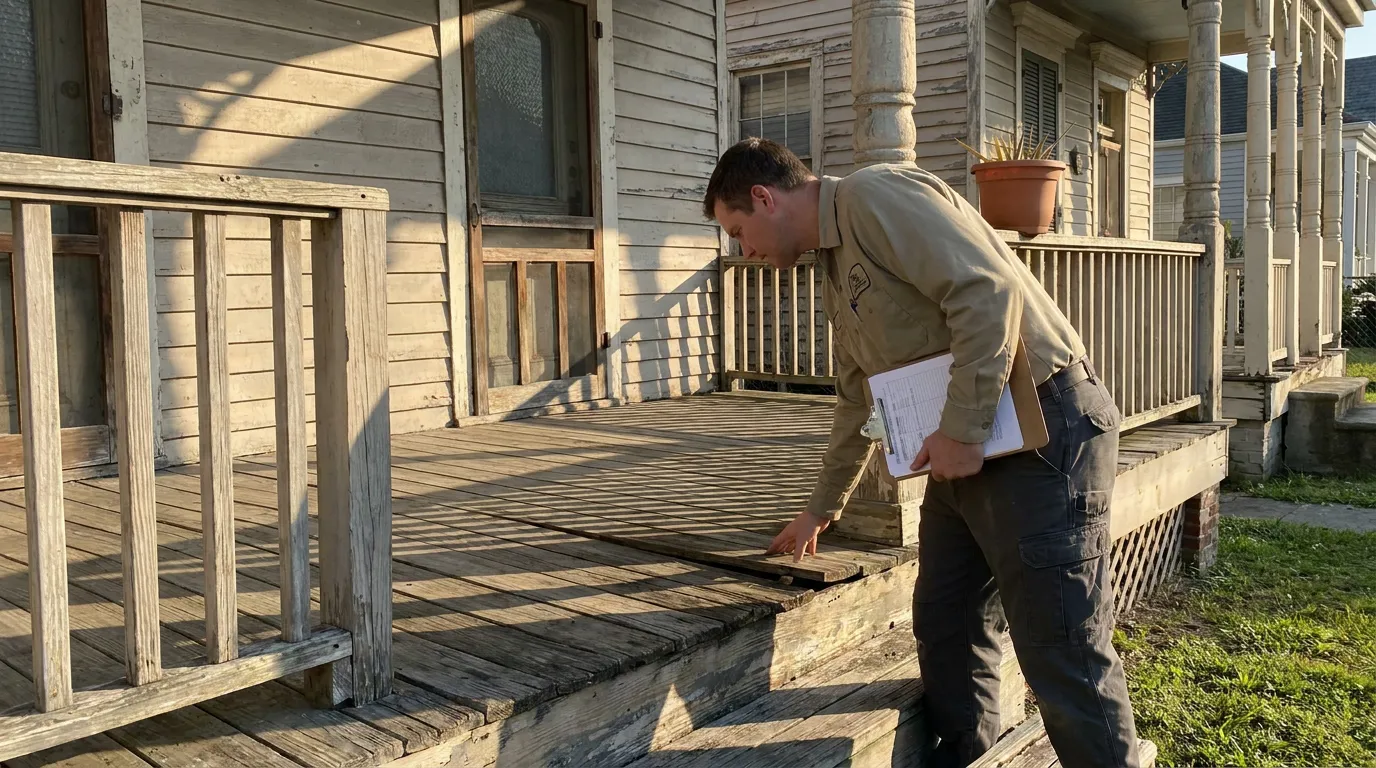
What Does Louisiana Civil Code Article 2322 Actually Say?
The statutory text is short, but every phrase carries weight. Article 2322 provides that "the owner of a building is answerable for the damage occasioned by its ruin, when this is caused by neglect to repair it, or when it is the result of a vice or defect in its original construction."
The second sentence is where most cases are won or lost. The statute continues that the owner "is answerable for damages only upon a showing that he knew or, in the exercise of reasonable care, should have known of the vice or defect which caused the damage, that the damage could have been prevented by the exercise of reasonable care, and that he failed to exercise such reasonable care." You can read the full building owner liability statute on the Louisiana Legislature’s website.
Why Does the 1996 Amendment Matter So Much?
The current version of Article 2322 comes from Acts 1996, 1st Ex. Sess., No. 1, §1, effective April 16, 1996. Before that amendment, Louisiana courts applied a strict liability framework under which an injured party often did not have to prove the owner’s awareness of the defect. The 1996 change added the knowledge and reasonable-care requirements, shifting the article toward a negligence-based standard.
Older articles and forum posts still describe Article 2322 as a pure strict liability rule. That description is outdated, and relying on it can lead injured people to underestimate how much evidence their case requires.
What Counts as "Ruin" Under the Owner Liability Statute in Louisiana?
"Ruin" generally refers to the fall or collapse of a building or component that has become part of the structure. Courts have applied the concept to collapsing galleries and balconies, failing stair treads, detaching handrails, falling ceiling panels, and deteriorating exterior walls. New Orleans has an enormous stock of historic buildings, and deferred maintenance on wood galleries, wrought iron, and aging brick creates structural risk.
Not every hazard on a property is "ruin." A puddle on a tile floor, a loose floor mat, or a spilled product usually falls under different Louisiana provisions such as Article 2317.1 or, for merchants, La. R.S. 9:2800.6. Cases typically turn on whether the dangerous condition was part of the building itself and whether it deteriorated or was built improperly.
| Element Under Article 2322 | What It Generally Requires |
|---|---|
| Ownership | The defendant owned the building at the time of the incident |
| Ruin | A structural failure or falling component of the building |
| Cause | Neglect to repair, or a vice or defect in original construction |
| Knowledge | Actual or constructive awareness of the vice or defect |
| Preventability | Reasonable care could have avoided the harm |
| Breach and damages | The owner failed to act, and injuries resulted |
How Does Article 2322 Interact With Other Louisiana Liability Rules?
Article 2322 does not exist in isolation, and many New Orleans injury claims plead more than one theory. Louisiana Civil Code Article 2317.1 imposes a parallel rule on owners and custodians of things generally, providing that the owner or custodian "is answerable for damage occasioned by its ruin, vice, or defect, only upon a showing that he knew or, in the exercise of reasonable care, should have known of the ruin, vice, or defect which caused the damage," along with the same preventability and failure-to-act requirements. The Louisiana Civil Code Online collection maintained by LSU Law includes helpful context on how these delictual liability provisions fit together.
Which article applies depends on whether the defective item is a building, a building component, or a separate thing on the property. Courts consider how permanently the item is attached, who had custody or garde, and whether a lease or other agreement shifted responsibility.
Can Res Ipsa Loquitur Help an Injured Person?
Yes, in some cases. Article 2322 expressly states that "nothing in this Article shall preclude the court from the application of the doctrine of res ipsa loquitur in an appropriate case." That doctrine allows a court to infer negligence from the nature of the accident itself when the cause of the ruin cannot be directly proven.
Res ipsa is not a shortcut, and courts apply it narrowly. It generally requires that the incident be of a kind that does not ordinarily occur absent negligence, that the defendant had control or responsibility for the instrumentality, and that other reasonable explanations be excluded.
What Evidence Strengthens a Building Ruin Claim?
Proving the owner’s knowledge is usually the hardest part, and evidence disappears fast. Property owners frequently repair or demolish the failed structure within days, destroying physical proof of deterioration. Understanding what must be proven in a premises liability case helps injured families see why early action matters.
Evidence that often proves valuable includes:
- Photographs and video of the failed structure taken immediately after the incident
- Prior code enforcement citations, permit records, or inspection reports
- Maintenance logs, work orders, and contractor invoices showing deferred repairs
- Tenant or neighbor complaints about sagging, cracking, or rot
- Medical records tying the injuries directly to the collapse
- Engineering analysis of the construction defect or deterioration pattern
💡 Pro Tip: If a structure failed and you are able, photograph the broken components from multiple angles before anything is cleaned up or hauled away. Rusted bolts, rotted joists, and separated masonry tell a story that a repaired building cannot.
How Long Do You Have to File a New Orleans Injury Claim?
Louisiana’s deadline for personal injury suits is generally two years from the date of injury for injuries occurring on or after July 1, 2024, and one year for injuries that occurred before that date. The prior one-year rule had made Louisiana one of the shortest filing deadlines in the country, but the new two-year period brings Louisiana more in line with other states. Missing the applicable window typically ends the claim regardless of facts. In building collapse cases involving catastrophic injuries such as traumatic brain injury, spinal cord damage, or fractures requiring multiple surgeries, that time can pass quickly while a family focuses on medical care.
Limited exceptions exist, but courts interpret them narrowly. Certain circumstances may affect when the clock begins or whether it is suspended or interrupted, and claims involving governmental entities can carry separate notice or procedural requirements.
What if You Were Partly at Fault?
As of January 1, 2026, Louisiana follows a modified comparative fault system under amended Civil Code Article 2323. If a judge or jury assigns an injured person 51% or more of the fault, that person is completely barred from recovering any damages. If the injured person is found less than 51% at fault, their recoverable damages are reduced in proportion to their percentage of fault. For causes of action accruing before January 1, 2026, the prior pure comparative fault system still applies, under which partial responsibility never barred recovery and damages were simply reduced by the plaintiff’s percentage of fault.
These arguments are common and are not necessarily the end of a case. How fault gets allocated depends on the specific facts, the warnings that existed, and the severity of the structural defect. A louisiana civil code article 2322 lawyer can evaluate how comparative fault arguments may realistically affect a claim.
Frequently Asked Questions
1. Does Article 2322 apply to apartments and rental properties in New Orleans?
Yes. The article addresses the owner of a building, so ownership or custody at the time of the ruin is a threshold question. Lease terms, management agreements, and who controlled repairs may all factor into who is answerable.
2. Is Article 2322 still a strict liability statute?
No. The 1996 amendment added the requirement that an injured party show the owner knew or should have known of the vice or defect, that reasonable care could have prevented the damage, and that the owner failed to exercise that care.
3. What if the building was defective when it was originally built?
Article 2322 expressly covers damage resulting from a vice or defect in original construction, not just neglected repairs. The knowledge and reasonable-care elements still apply, and claims against builders may be governed by separate laws and deadlines.
4. Can a wrongful death claim be brought under this article?
Yes, when a building’s ruin causes a fatality, Louisiana law permits a defined ranked class of surviving family members to pursue wrongful death and survival claims. These cases are fact-intensive and time-sensitive.
5. Do I need an engineer to prove my case?
Often, yes. Engineering analysis helps establish whether the failure resulted from deterioration or a construction defect and whether reasonable inspection would have revealed it. Whether such testimony is needed depends on the facts.
Bringing It Together for Injured Louisiana Families
Article 2322 gives people injured by collapsing balconies, failing staircases, and crumbling structures a defined path to hold building owners accountable. The statute requires proof of ownership, ruin, causation, and the owner’s actual or constructive knowledge of the defect. Because the filing deadline is short and physical evidence often vanishes within days, families are generally in a stronger position when they consult an attorney early.
If a structural failure has changed your family’s life, Smiley Law Firm is ready to listen. Call our Louisiana personal injury attorneys at (504) 822-2222 or request your free case review to discuss your options.