
When a Trucking Company’s Hiring Decision Becomes Part of Your Injury Case
Key Takeaways: A negligent hiring claim against a New Orleans trucking company asserts that the motor carrier itself acted unreasonably by hiring, retaining, or supervising an unqualified or dangerous driver. Unlike vicarious liability, which attributes the driver’s conduct to the employer, this theory targets the company’s own decision-making and may help address arguments that the driver was an independent contractor or outside the scope of employment. Louisiana anchors employer liability in Civil Code arts. 2315 and 2320, while FMCSA rules under 49 C.F.R. Part 391, including the § 391.23 safety performance history inquiry, can inform the applicable standard of care. Proof usually lives in the carrier’s own records, driver qualification files, motor vehicle records, drug and alcohol testing, prior crash history, and internal hiring policies, much of which can be lost quickly without a prompt preservation letter. Filing deadlines depend on the crash date: most delictual actions on or after July 1, 2024 face a two-year prescriptive period under La. Civ. Code art. 3493.11, while earlier claims generally remained subject to one year, and certain claims follow their own rules. Multiple parties may share responsibility, and Louisiana’s comparative fault rules also turn on the accident date, with pure comparative fault applying before January 1, 2026 and a modified 51% bar applying after.
A negligent hiring claim seeks to hold the motor carrier responsible for its own conduct in putting an unqualified or dangerous driver behind the wheel. Instead of focusing only on what the driver did before impact, this theory asks whether the person should have been hired at all. Injured Louisianans may pursue both a claim against the driver and a separate claim against the carrier for hiring, screening, retention, training, and supervision failures.
If you or a family member was seriously hurt in a collision with an 18-wheeler in Orleans Parish or anywhere across Louisiana, the hiring records that matter most may already be sitting in a carrier’s file cabinet. Smiley Law Firm helps Louisiana families investigate how a commercial driver came to be on the road in the first place. Call (504) 822-2222 or contact us now to schedule a free consultation.
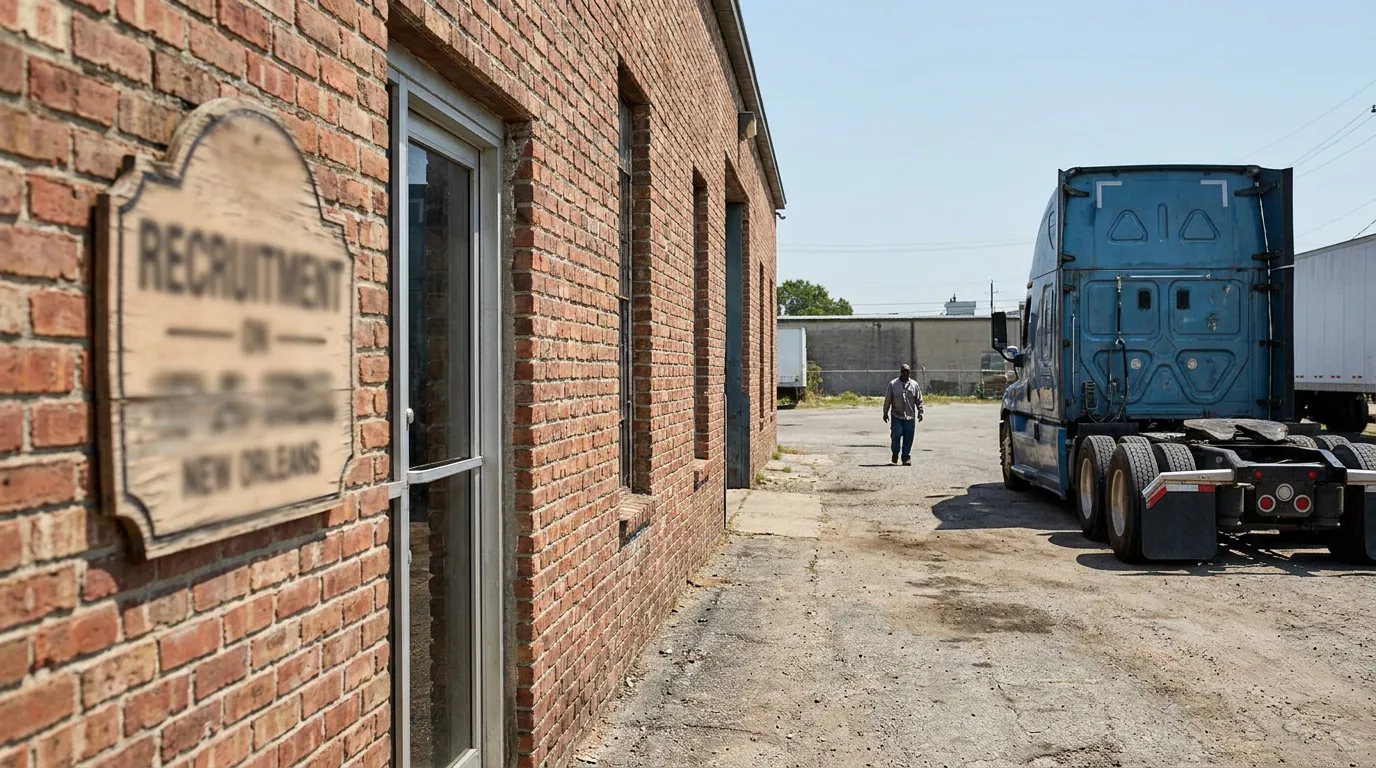
What Makes a Negligent Hiring Claim Different?
A negligent hiring claim targets the carrier’s own decision-making rather than simply attributing the driver’s mistakes to the employer. Most truck accident cases begin with vicarious liability, or respondeat superior. Under that doctrine, an employer is generally answerable for wrongful acts an employee commits within the course and scope of employment, as explained in the respondeat superior doctrine overview from Cornell’s Legal Information Institute.
Direct negligence works differently: here, the carrier itself is the alleged wrongdoer. The claim asserts the company failed to use reasonable care in hiring, retaining, or supervising the driver, and that failure caused the crash.
Why Pursue Both Theories at Once?
Plaintiffs in Louisiana may plead vicarious liability and hiring negligence together. Carriers sometimes dispute whether a driver was an employee or independent contractor, or whether the driver acted within the scope of employment. A direct negligence claim may not depend on resolving those questions the same way, though a carrier’s admission of vicarious liability can sometimes affect how a court handles the direct negligence theory.
The two theories also may open different evidentiary doors. Vicarious liability focuses on the crash itself. Direct negligence may open the carrier’s internal files, safety history, and corporate decision-making to scrutiny, subject to the trial court’s rulings on relevance and prejudice.
| Consideration | Vicarious Liability | Negligent Hiring (Direct Negligence) |
|---|---|---|
| Whose conduct is at issue | The driver’s | The trucking company’s |
| Core question | Was the driver at fault within the scope of employment? | Did the carrier use reasonable care in hiring or retaining this driver? |
| Key evidence | Crash reconstruction, black box data, logs | Driver qualification file, prior employer inquiries, MVR, hiring policies |
| Common carrier defense | Independent contractor status; outside scope of employment | Screening was adequate; no foreseeable risk |
Where Does Louisiana Law Anchor Employer Liability?
Louisiana is a civil law jurisdiction, and employer liability principles flow from the Civil Code. Article 2320 addresses employer responsibility for damage caused by employees in the exercise of their functions, attaching liability only when the employer might have prevented the act and did not. Article 2315 supplies the broader duty framework, providing that every act causing damage to another obliges the person at fault to repair it.
Louisiana courts generally apply a duty-risk analysis, asking whether a duty existed, whether it was breached, whether the breach caused the harm, whether the risk fell within the scope of the duty, and whether damages resulted. Academic commentary from the Louisiana Law Review at LSU’s Paul M. Hebert Law Center has examined how these doctrines interact in the employer liability context. Outcomes remain fact-dependent, and courts may weigh foreseeability closely.
What Federal Rules Set the Hiring Standard of Care?
FMCSA rules can give plaintiffs a useful yardstick for measuring whether a carrier’s hiring practices fell short. Under 49 C.F.R. Part 391, motor carriers must maintain a driver qualification file and verify that a driver is legally qualified, generally including reviewing the driving record, confirming licensing and medical certification, and documenting the process.
One requirement comes up repeatedly in this litigation. Under 49 C.F.R. § 391.23, a carrier must investigate the driver’s safety performance history with DOT-regulated employers for the preceding three years. FMCSA’s driver qualification file requirements guidance walks carriers through those steps, so a carrier that skipped them may have difficulty claiming it didn’t know what was expected.
Louisiana layers state regulation on top of this, adopting much of the federal safety and driver-qualification framework for carriers operating in the state, including many intrastate carriers, though the scope of adoption and any exemptions should be confirmed for the particular carrier. Readers wanting a deeper look can consult a lawyer familiar with how federal regulations interact with Louisiana claims.
💡 Pro Tip: Regulatory violations do not automatically establish liability. Louisiana courts generally treat a rule violation as evidence relevant to breach rather than negligence per se, and you must still connect that breach to your specific harm.
What Evidence Supports a Hiring Negligence Claim?
The proof generally lives inside the carrier’s own paperwork, which is one reason early legal action matters. A negligent hiring theory typically rises or falls on documents the trucking company controls and has little incentive to volunteer. Common categories include:
- The driver qualification file, including the application and prior employer inquiries
- Motor vehicle records showing prior citations, suspensions, or serious violations
- Pre-employment and post-accident drug and alcohol testing records
- Prior crash history, both with this carrier and previous employers
- Internal hiring criteria, training curricula, and safety department communications
- Dispatch records and prior complaints about the driver’s conduct
Patterns often matter more than any single document. A driver with one old citation may present a different case than one hired despite a suspended license, a positive test result, or a string of preventable collisions. Courts may consider whether the carrier knew, or through reasonable inquiry should have known, of a risk making this driver unsuitable for the route and equipment assigned. Some records, particularly drug and alcohol testing files, are also subject to federal confidentiality rules that shape how they’re obtained in litigation.
How Quickly Can This Evidence Disappear?
Retention periods for trucking records are often short, and some data may overwrite itself within days. Electronic control module data, dispatch messages, and telematics can be lost through routine operation. A preservation letter sent promptly after a Louisiana truck crash may help preserve those records before they vanish.
How Does Timing Affect a New Orleans Truck Accident Case?
Louisiana’s filing deadline depends on when the crash occurred. For delictual actions on or after July 1, 2024, La. Civ. Code art. 3493.11 provides a two-year prescriptive period; earlier claims generally remained subject to a one-year period, and certain categories, including some medical malpractice and product liability actions, follow their own rules. Wrongful death claims are governed by a separate provision generally running from the date of death, so the applicable deadline should be confirmed for the specific facts. Even a two-year window can be tight in trucking cases, where identifying every potentially responsible party may take months.
Limited exceptions exist and are interpreted narrowly. Contra non valentem and discovery-type principles may suspend prescription in certain circumstances, but courts apply these doctrines cautiously and don’t extend deadlines automatically. Claims involving public entities may involve separate notice or procedural requirements distinct from the civil prescriptive period, so no one should assume an extension applies without case-specific review.
💡 Pro Tip: Do not wait for an insurance adjuster to finish its own "investigation" before speaking with an attorney. Prescription generally continues to run while a claim is being evaluated unless interrupted or suspended under the Civil Code.
Who Else May Share Responsibility in an 18-Wheeler Injury Case?
Commercial trucking cases frequently involve several potentially liable parties beyond the driver, each carrying separate insurance coverage. Depending on the facts, potential defendants can include the motor carrier, the trailer or tractor owner, a broker or shipper, a maintenance contractor, and a cargo loading company. Sorting out these relationships early is one reason families across the New Orleans metro, Metairie, Mandeville, and Baton Rouge benefit from involving a negligent hiring claim against trucking company lawyer as soon as possible.
Louisiana’s comparative fault rule also depends on the accident date. For accidents before January 1, 2026, Louisiana applied pure comparative fault, under which an injured person could recover a reduced award at any percentage of fault. For accidents on or after that date, Act 15 of 2025 amended La. Civ. Code art. 2323 to adopt a modified system barring recovery when a claimant is more than 50% at fault, reducing the award proportionally otherwise. Carriers and insurers often argue comparative fault aggressively, so documenting the sequence of events carefully may help protect the full value of a claim.
Frequently Asked Questions
1. Does a negligent hiring claim require proving the driver was an employee?
Not necessarily in the same way vicarious liability does. Because direct negligence focuses on the carrier’s own selection and oversight decisions, it may remain available even where the company argues the driver was an independent contractor, though specific facts, contract terms, and federal obligations will influence the analysis.
2. What if the carrier says it ran a background check?
Documentation of a check is a starting point, not an ending point. Courts may consider whether the inquiry actually satisfied 49 C.F.R. § 391.23, whether the carrier reviewed what it received, and whether it acted reasonably on information suggesting the driver posed a risk.
3. Can a hiring negligence claim increase the value of a truck accident case?
It may affect the scope of recoverable damages and the parties available to pay, but no outcome can be promised. Direct negligence claims may expose corporate conduct that a jury weighs differently than a single driver’s momentary error, and results always depend on the specific facts and law that apply.
4. Is Louisiana’s filing deadline ever extended in trucking cases?
Only in limited circumstances. Louisiana recognizes narrow doctrines that may suspend or interrupt prescription, but courts generally construe them strictly, and relying on a possible exception is risky. Because the applicable period turns on the date of the crash and type of claim, consulting an attorney well before any potential deadline is the safer course.
5. What should I do with the police report and medical records?
Keep organized copies of everything, including the crash report, imaging, bills, and any correspondence from insurers. These records may help establish both liability and the severity of injuries such as traumatic brain injury, spinal cord damage, or burns.
Protecting Your Rights After a Louisiana Truck Crash
A negligent hiring claim shifts attention from a single moment on the highway to the carrier’s decision to entrust a heavy commercial vehicle to a particular driver. Louisiana’s Civil Code framework, federal driver qualification rules, and state motor carrier regulations together may give injured families a way to examine that decision. Because the evidence is controlled by the carrier and prescriptive deadlines can pass before an investigation is complete, the strength of a claim often depends on how quickly the investigation begins. Every situation turns on its own facts, so speak with an attorney about your specific circumstances.
Serious truck accident injuries deserve a serious investigation into how the crash happened and why. The team at Smiley Law Firm is respected for handling commercial trucking cases across New Orleans and throughout Louisiana. Call (504) 822-2222 or reach out to our Louisiana personal injury attorneys today.
Disclaimer: This content is for informational purposes only and is not legal advice. Every case is unique, and results may vary. Consult an attorney about your specific circumstances.